In addition to the technically required cookies, our website also uses cookies for statistical evaluation. You can also use the website without these cookies. By clicking on "I agree" you agree that we may set cookies for analysis purposes. You can see and change your cookie settings here.
This collection item does not have a name in the language of origin. If you know the name or have comments, use this form to contact the data-providing institution.
The Wuppertal textiles from what is now Indonesia came from Eduard von der Heydt, who gave them to the Städtisches Museum Wuppertal in 1937. The museum bought them from the art dealer Carel van Lier in Amsterdam. They were originally part of the curated collection of the German-Jewish banker Georg Tillmann, who lived in Amsterdam from 1932. Of the original 80 textiles, 68 have survived to this day, including fabrics from the islands of Java, Sumatra, Timor, Borneo and Bali in ikat, songket or batik techniques. Most of the pieces were created in the late 19th and early 20th centuries, when what is now Indonesia was under Dutch colonial rule.
Former object number W 26.
Probably a sarong for women.
Consists of half-silk (warp: silk, weft: cotton) and metal threads. Open-weave, plain-weave, salmon red half-silk fabric with polychrome warp thread pairs forming warp stripes and fine white and blue-violet weft stripes. The pattern on the kepala and on the upper and lower edges of the sarong is formed by launched and brocaded gilded metal threads (metal lace around the thread core). The pattern weft is inserted after every third ground weft. The pattern weft threads float openly on the back of the fabric.
The sarong is composed of two woven panels with a hand-finished fell seam in the centre and is also closed at the sides with a fell seam to form a tubular shape. The white selvedges running along the top and bottom edges are not finished.
presumably after 1932-presumably June 1935: Georg Tillmann (1882-1941), Amsterdam | [...]-presumably June 1935: Kunstzaal Van Lier by Carel van Lier, Amsterdam. June 1935: Kunstzaal Van Lier by Carel van Lier, Amsterdam; on commission from the aforementioned | June 1935-1964: Eduard Freiherr von der Heydt (1882-1964), Ascona [on loan to the Städtisches Museum Wuppertal, since spring 1937] | 1964-today: Von der Heydt-Museum Wuppertal; donation by Eduard Freiherr von der Heydt, Ascona (as at: 03.04.2025)
This collection item does not have a name in the language of origin. If you know the name or have comments, use this form to contact the data-providing institution.
Save
Sarong, Java, Semarang or Lasem
This collection item does not have a name in the language of origin. If you know the name or have comments, use this form to contact the data-providing institution.
Save
Sarong, Savu
This collection item does not have a name in the language of origin. If you know the name or have comments, use this form to contact the data-providing institution.
Save
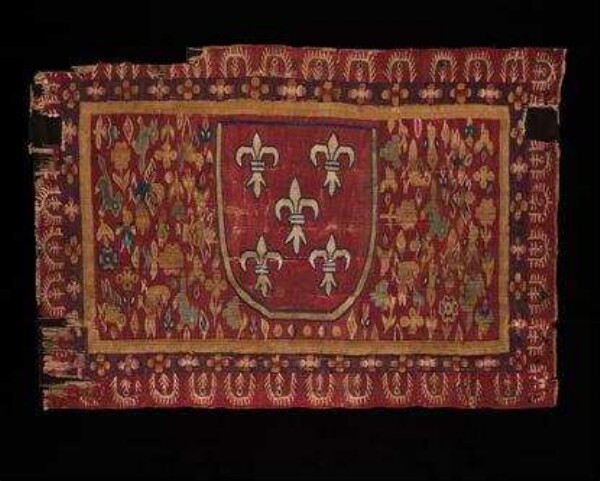
Fabric fragment with heraldic lily and bird motif
This collection item does not have a name in the language of origin. If you know the name or have comments, use this form to contact the data-providing institution.
Save
Selimut (shawl for men), Central Timor
This collection item does not have a name in the language of origin. If you know the name or have comments, use this form to contact the data-providing institution.
Save
Selendang, (shawl), Sumatra, Toba-Batak
This collection item does not have a name in the language of origin. If you know the name or have comments, use this form to contact the data-providing institution.
Save
Hip scarf, Sumatra, Minangkabau
This collection item does not have a name in the language of origin. If you know the name or have comments, use this form to contact the data-providing institution.
Save
Shawl, Java?
This collection item does not have a name in the language of origin. If you know the name or have comments, use this form to contact the data-providing institution.
Save
Wedding scarf, Aceh
This collection item does not have a name in the language of origin. If you know the name or have comments, use this form to contact the data-providing institution.
Save
Shoulder scarf, Sulawesi
This collection item does not have a name in the language of origin. If you know the name or have comments, use this form to contact the data-providing institution.