In addition to the technically required cookies, our website also uses cookies for statistical evaluation. You can also use the website without these cookies. By clicking on "I agree" you agree that we may set cookies for analysis purposes. You can see and change your cookie settings here.
This collection item does not have a name in the language of origin. If you know the name or have comments, use this form to contact the data-providing institution.
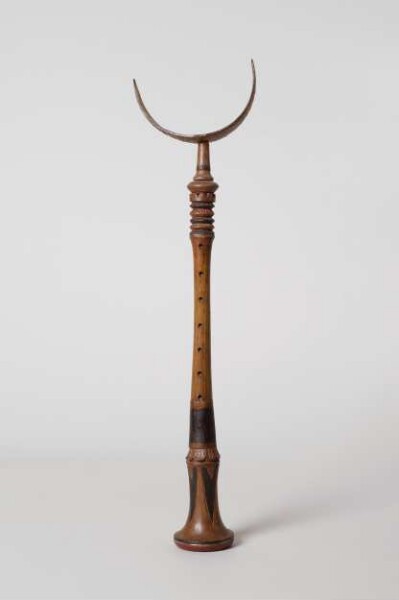
This Iranian surnā(j) is characterised by its dark red coloured wood. The tip of the body of the woodwind instrument with double reed is decorated with a hammered brass ring below the fork insert. The funnel is decorated with four circumferential rows of around 60 brass nails. The lip disc is made of soft white plastic.
This collection item does not have a name in the language of origin. If you know the name or have comments, use this form to contact the data-providing institution.
Save
Clay whistle
kisir
Information about the language not available
Save
kisir
doc
Information about the language not available
Save
Flute
This collection item does not have a name in the language of origin. If you know the name or have comments, use this form to contact the data-providing institution.
Save
Bell in the shape of a miniature mask
mu yü
Information about the language not available
Save
mu yü
This collection item does not have a name in the language of origin. If you know the name or have comments, use this form to contact the data-providing institution.
Save
Tarompèt
zurna
Information about the language not available
Save
Zurna
This collection item does not have a name in the language of origin. If you know the name or have comments, use this form to contact the data-providing institution.
Save
Clay flute
gêsba
Information about the language not available
Save
gêsba
This collection item does not have a name in the language of origin. If you know the name or have comments, use this form to contact the data-providing institution.
Save
Rgya-gling
This collection item does not have a name in the language of origin. If you know the name or have comments, use this form to contact the data-providing institution.