Rights management: Linden-Museum Stuttgart
Attribution - NonCommercial - NoDerivs 4.0 International
Full screen
Initial display
Zoom in
Zoom out
Previous image
Next image
Downloads the object

This collection item does not have a name in the language of origin. If you know the name or have comments, use this form to contact the data-providing institution.
Arrows


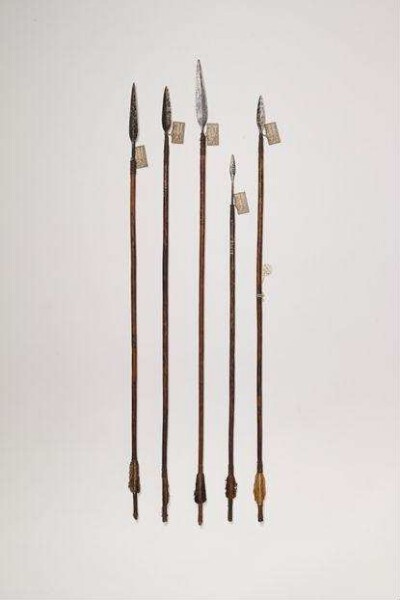
Skilfully designed and crafted so as to function efficiently under specific conditions and for specific types of prey, in Namibia arrows were also elegantly shaped and decorated so as to provide an aesthetic effect. Thus, they not only performed a specific function, but also expressed both the cosmology and the personality of their owners. Text: Sandra Ferracuti.
- Data Provider
- Linden-Museum Stuttgart Staatliches Museum für Völkerkunde Show original at data provider
Cataloguing data
- Cultural attribution
- San
- Object type
- Pfeil
- Dimensions
- Length: 51 cm
- Material/Technique
-
Pipe, Tendon, Leg
carved, plugged in, wrapped
- Current location
- Linden-Museum Stuttgart
- Inventory number
- 028250
Provenance and sources
-
Assignment to a curated holding:
-
Production
-
when
-
around 1900
-
-
Change of physical control or legal title
-
where
-
Namibia
-
-
Change of physical control
-
when
-
1903
-
- Provenance
-
Dr. Anton Lübbert initially sent the collection to the Ethnological Museum in Berlin on the basis of the so-called Bundesrat resolution of 1889. Before it was forwarded to Stuttgart, Felix von Luschan selected and sorted the material there. In German South-West Africa, Lübbert had objects procured through "his collectors". Only a few months after the outbreak of the Herero-German War, in September 1904, Lübbert wrote to Linden that "it is already almost completely impossible to get Herero items". He had therefore "had the last stocks, which were in the hands of farmers and traders, bought up".
Text: Christoph Rippe.
Information about the record
- Legal status metadata
- CC BY-NC-ND 4.0 DEED
Related objects

This collection item does not have a name in the language of origin. If you know the name or have comments, use this form to contact the data-providing institution.
Save
Arrow

This collection item does not have a name in the language of origin. If you know the name or have comments, use this form to contact the data-providing institution.
Save
Arrow

This collection item does not have a name in the language of origin. If you know the name or have comments, use this form to contact the data-providing institution.
Save
Arrow
This collection item does not have a name in the language of origin. If you know the name or have comments, use this form to contact the data-providing institution.
Save
Arrows

This collection item does not have a name in the language of origin. If you know the name or have comments, use this form to contact the data-providing institution.
Save
Arrow

This collection item does not have a name in the language of origin. If you know the name or have comments, use this form to contact the data-providing institution.
Save
Arrow

This collection item does not have a name in the language of origin. If you know the name or have comments, use this form to contact the data-providing institution.
Save
Arrow

This collection item does not have a name in the language of origin. If you know the name or have comments, use this form to contact the data-providing institution.
Save
Arrow

This collection item does not have a name in the language of origin. If you know the name or have comments, use this form to contact the data-providing institution.
Save
Arrow

This collection item does not have a name in the language of origin. If you know the name or have comments, use this form to contact the data-providing institution.
Save
Arrow

This collection item does not have a name in the language of origin. If you know the name or have comments, use this form to contact the data-providing institution.
Save
Arrow
This content was machine-translated