In addition to the technically required cookies, our website also uses cookies for statistical evaluation. You can also use the website without these cookies. By clicking on "I agree" you agree that we may set cookies for analysis purposes. You can see and change your cookie settings here.
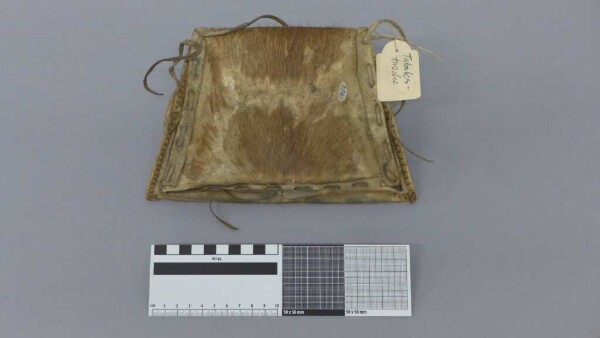
In the museum documentation, "Mandjia" was used as a cultural attribution. The term "Arnado" used on the index card is a pejorative term for non-members of Muslim Fulbe groups. It was adopted by German colonial officers and officials in written sources and referred to the head of non-Muslim groups in the North and Far North regions of Cameroon.
Ethnologische Sammlung der Georg-August-Universität Göttingen
Inventory number
ESG_Af 2028
Other number(s)
Berliner Inv. Nr. III C 22009 b (Akte Nr. E 1977/07) (Old inventory number)
Related object(s)
is part of :
Museum für Völkerkunde Berlin 1939 (Konvolut)
Provenance and sources
Production
when
Before 1907
Change of physical control or legal title: Unknown type of acquisition
where
Africa, Cameroon, Far North, Mandji
who
Museum für Völkerkunde Berlin - Former Possessors
Description
As a resident of the Adamaua administrative district, Kurt Strümpell carried out violent military interventions in the north of the German colony of Cameroon. He also undertook geographical, ethnographic and linguistic research. Between 1902 and 1907, he donated around 700 objects to the Braunschweig Municipal Museum. Numerous objects from Kurt Strümpell's collections ended up in the Ethnological Museum Berlin along with his photographic estate.
Change of physical control or legal title: Donation
when
1939
where
Ethnological Collection of the Georg-August-University Göttingen
who
Museum für Völkerkunde Berlin (heute Ethnologisches Museum Berlin)
Secondary literature
Bestandskatalog Afrika (IV) der Ethnologischen Sammlung der Georg-August-Universität Göttingen (hrsg. von P. Fuchs/ G. Krüger, Göttingen 1993), online unter https://www.uni-goettingen.de/de/617641.html
This collection item does not have a name in the language of origin. If you know the name or have comments, use this form to contact the data-providing institution.
Save
Bow with two arrows (set)
This collection item does not have a name in the language of origin. If you know the name or have comments, use this form to contact the data-providing institution.
Save
Alcelaphus lichtensteinii, Africa
This collection item does not have a name in the language of origin. If you know the name or have comments, use this form to contact the data-providing institution.
Save
Jewellery fragments
This collection item does not have a name in the language of origin. If you know the name or have comments, use this form to contact the data-providing institution.
Save
Arrow
This collection item does not have a name in the language of origin. If you know the name or have comments, use this form to contact the data-providing institution.
Save
Wooden chair
This collection item does not have a name in the language of origin. If you know the name or have comments, use this form to contact the data-providing institution.
Save
Drinking or scooping horn
This collection item does not have a name in the language of origin. If you know the name or have comments, use this form to contact the data-providing institution.
Save
Pouch, tobacco pouch
This collection item does not have a name in the language of origin. If you know the name or have comments, use this form to contact the data-providing institution.
Save
Alcelaphus buselaphus, Africa
This collection item does not have a name in the language of origin. If you know the name or have comments, use this form to contact the data-providing institution.
Save
Alcelaphus lichtensteinii, Rhofumbo, Mozambique
This collection item does not have a name in the language of origin. If you know the name or have comments, use this form to contact the data-providing institution.
Save
Dagger
This collection item does not have a name in the language of origin. If you know the name or have comments, use this form to contact the data-providing institution.