In addition to the technically required cookies, our website also uses cookies for statistical evaluation. You can also use the website without these cookies. By clicking on "I agree" you agree that we may set cookies for analysis purposes. You can see and change your cookie settings here.
This collection item does not have a name in the language of origin. If you know the name or have comments, use this form to contact the data-providing institution.
The Kurumba region lies on a high plateau at an altitude of up to 2600 metres and is bordered by dense tropical forest. The remote location and difficult climatic conditions have transformed this area into a kind of natural biological island that has been able to maintain its seclusion for centuries. The Kurumba language is still spoken by an estimated 4,900 people. Within India, the area stretches across three states with three different languages and three different school systems, creating a precarious situation for the Kurumba. The trend towards wildlife tourism is also proving to be a further threat to both the people and the ecosystem. (Source: http://www.kooperation-international.de/indien/geistes-und-sozialwiss/info/detail/data/42305/?PHPSESSID=ccee5d58af4196810779567d17114706) 3 barefoot women of different ages wrapped in shawls stand or squat in front of a rock face (rock face see also VIII C 213)
This collection item does not have a name in the language of origin. If you know the name or have comments, use this form to contact the data-providing institution.
Save
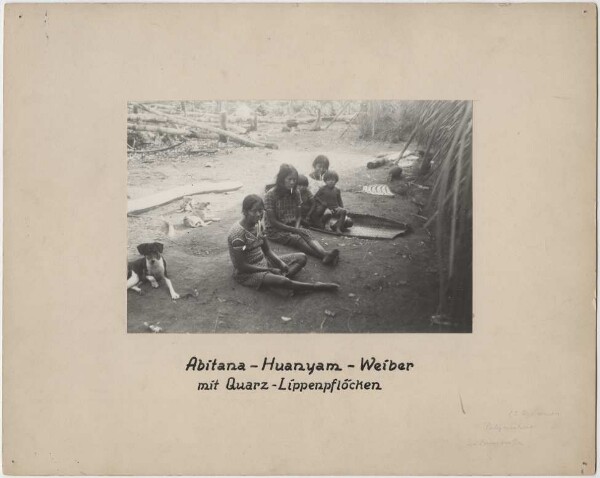
Abitana-Huanyam women with lipstones
Image not available
This collection item does not have a name in the language of origin. If you know the name or have comments, use this form to contact the data-providing institution.
Save
Open steel cabinets in the magazine
This collection item does not have a name in the language of origin. If you know the name or have comments, use this form to contact the data-providing institution.
Save
"Frieze of the Jaguar Temple"
This collection item does not have a name in the language of origin. If you know the name or have comments, use this form to contact the data-providing institution.
Save
Ashluslay from the Rio Pilcomayo
This collection item does not have a name in the language of origin. If you know the name or have comments, use this form to contact the data-providing institution.
Save
Reopening ceremony in the atrium of the Museum of Ethnology with the cast of the eastern gate of Sântschî (Bhôpâl) (Sanchi)
This collection item does not have a name in the language of origin. If you know the name or have comments, use this form to contact the data-providing institution.
Save
Four women from Eten, one with a child
This collection item does not have a name in the language of origin. If you know the name or have comments, use this form to contact the data-providing institution.
Save
Chané
This collection item does not have a name in the language of origin. If you know the name or have comments, use this form to contact the data-providing institution.
Save
"Indio Bororó, Rio San Lorenzo"
This collection item does not have a name in the language of origin. If you know the name or have comments, use this form to contact the data-providing institution.
Save
Settler couple
This collection item does not have a name in the language of origin. If you know the name or have comments, use this form to contact the data-providing institution.
Save
Indio Chamacoco, "Millet", Puerto 14 de Mayo
This collection item does not have a name in the language of origin. If you know the name or have comments, use this form to contact the data-providing institution.