In addition to the technically required cookies, our website also uses cookies for statistical evaluation. You can also use the website without these cookies. By clicking on "I agree" you agree that we may set cookies for analysis purposes. You can see and change your cookie settings here.
This collection item does not have a name in the language of origin. If you know the name or have comments, use this form to contact the data-providing institution.
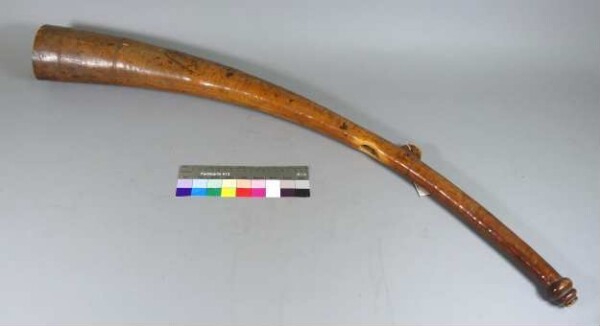
The Tibetan cult instruments are built as identical pairs - in contrast to the Tibetan-Buddhist instrument pairs, which differ in details. The two Rgya-gling instruments VII c 1028/1029 are hand-cut from black wood. Eight copper rings are attached between the tone holes. Riveted plant ornaments adorn the widely projecting funnel made of hammered copper. Two eyelets on the funnel and two below the top of the body provide support for two carrying chains. The pipe support is particularly splendid with its vase-like shape, above which a lid appears to float. This is held by four richly decorated clasps, each adorned with a coral. The lip disc is attached to the tube carrier on a delicate metal chain.
This collection item does not have a name in the language of origin. If you know the name or have comments, use this form to contact the data-providing institution.
Save
Tambourine
cauktika vina
Information about the language not available
Save
çauktika vina
This collection item does not have a name in the language of origin. If you know the name or have comments, use this form to contact the data-providing institution.
Save
Single transverse flute
hasapi (hapetan)
Information about the language not available
Save
hasapi (hapetan)
fisqa
Information about the language not available
Save
Clay whistle
dondo
Information about the language not available
Save
dondo
This collection item does not have a name in the language of origin. If you know the name or have comments, use this form to contact the data-providing institution.